
By Dr Mariya Ali
Every day, child protection professionals walk into work carrying a weight that is rarely acknowledged. They listen to disclosures of abuse, make decisions that can alter the course of a child’s life, and shoulder the emotional residue of trauma that is often too distressing for most people to hear. Yet despite this immense responsibility, many agencies are unknowingly operating in what can only be described as survival mode.
On the train back from speaking about MOT for child protection professionals at the SACPA Annual Safeguarding Conference, I sat next to a woman on the train who bought herself two small bottles of vodka, which she drank within 30 minutes. I felt she wanted to talk. We started talking about the weather at first, then she shared what had happened to her that day; the culture of fear in her workplace, and colleagues who felt trapped but unable to walk away because they “had families to look after.” She elaborated that many of her colleagues wanted to leave the organisation but simply cannot afford to lose their job. “Finding a new job these days is hard,” she added. Her anxiety was palpable. When I looked around the train carriage, many others carried the same expression of tension and exhaustion, the look of people who have been operating in stress for too long.
I felt for this lady, who was going to have to do the same thing all over again tomorrow, the day after and the day after that!
I asked myself; if every person in the train carriage decided to share their thoughts, how many would share a similar story? And then I looked at people’s faces. Many had frowns: appearing either worried or angry. Some had deep stress lines and bit their nails. Most of them were distracting themselves on their mobile phones. Amongst the carriage full of people, if you had a happy, relaxed look on your face, you would be the odd one out.
Whilst mental health is on everyone’s radar these days, what are the steps organisations are taking to change the culture of their organisations, to lean into a more conscious and compassionate management style? After all, research after research shows that mindful management helps increase productivity and innovative thinking and improves the communication skills and mental health of both employees and leaders. Dr Daniel Goleman in his book Primal Leadership (2002) talks about how the leader sets the tone of the organisation.
In child protection, this experience is magnified. The system is stretched, scrutiny is constant, and the emotional load is immense. Staff work tirelessly to protect children yet often have little left to protect themselves. When organisations are overwhelmed by demand, caseload pressures, public expectations or insufficient resources, they begin to mirror the same survival responses we see in traumatised individuals: hypervigilance, reactivity, defensiveness, and emotional shutdown (Steen at. Al, 2020). It is difficult to build a safe, thoughtful safeguarding culture when the workforce is fighting simply to get through the day.
Child protection professionals understand trauma well when it appears in the lives of children and families. But we speak less openly about the trauma that is absorbed indirectly every day by practitioners themselves. Vicarious trauma is not theoretical; it is the lived experience of staff who spend their days listening to stories of violence, neglect, exploitation and loss. Over time, these experiences shape the nervous system: sleep becomes difficult, irritability increases, empathy fades, and detachment become a coping mechanism (Steen. Et, al., 2020). Eventually, without intervention, vicarious trauma turns into burnout, a state of emotional and physical depletion that has become far too common in safeguarding.
The science behind this is well established. When the brain is exposed to chronic pressure, it shifts from the calm, rational thinking of the neocortex into the instinctive survival responses of the brain stem. Blood moves away from the areas responsible for planning, empathy, creativity and decision-making, and rushes instead to prepare the body for fight, flight or freeze. In this state, even the most experienced professional may miss cues, struggle to regulate their emotions or make decisions driven more by fear than judgement. These are the reasons why we must take actions that help us connect to the origins of our behaviour.
This is where the brain comes in!
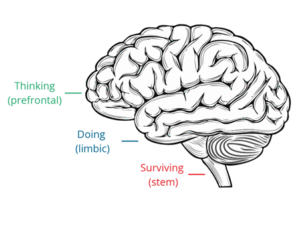
- Brain stem (being) The brain stem is largely unconscious; it controls the flow of messages between the brain and the rest of the body. It is your auto-pilot; controlling basic body functions such as breathing, swallowing, digestion, heart rate, blood pressure, temperature control, consciousness and whether we are awake or sleepy. It’s highly resistant and lives in survival mode.
- Limbic (doing) The limbic system is the portion of the brain that deals with three key functions: emotions, memories and stimulation. It is your subconscious; responsible for thinking, movement, feelings, memory, including long-term memory formation and the centre that controls our hormones.
- Neocortex (thinking) The neocortex is involved in higher functions such as logic, planning, conscious thought, decision making, language, communication and evolving. This part of the brains stops us from screaming back at our boss!
Dr Bruce Lipton (2005), states that 95% of all our decision making is subconscious and only 5% is conscious. So, how can we engage with the 95% and implement change?
The 95% is what we absorb from parents, teachers, childcare and the culture we grow up around. This largely occurs below the age of 7. Therefore, when we are confronted with a situation, information collected by our five senses are sent to the brain stem via the spinal cord, which then sends a message to the limbic brain that searches the library of experiences, memories and events. This is why a particular scent or hearing a certain song ignites feelings of pleasure or pain. If the brain registers a certain smell as danger, it triggers an alarm that is sent to the amygdala, which sends a distress signal to the hypothalamus (are of the brain that communicates with the rest of the body). This activates the release of adrenaline from the adrenal glands and the stress hormone cortisol to prepare the body to fight, flight or freeze. These neurological and somatic responses can be best understood through Dr Stephen Prorges’ Polyvagal Theory (2017) and Dr Peter Levine’s Somatic Experiencing (Levine & Fredrick, 1997).
These unconscious programmes that are stored in the brain stem make sure that reactions are automatic to keep us safe. That’s why when we are faced with a stressful situation our childhood programming kicks in. So, stressful work environments take us back to our childhood programming.
Many of us find ourselves in these highly charged work environments where are constantly stressed. Our bodies do not get a break from the constant release of stress hormone cortisol. Research shows that long-term exposure to chronic stress can lead to the deterioration of our physical and psychological health. When in survival mode blood is diverted from decision-making centres (cortex) to prepare the body to fight or flight, causing people to miss vital cues and are more likely to make more mistakes according to Esaki & Larkin (2013).
According to Daniel Goleman, Richard Boyatzis and Annir McKee in their book Primal Leadership: “No creature can fly with one wing. Gifted leadership occurs where heart and head – feeling and thought – meet. These are the two wings that allow a leader to fly.”
This quote highlights the importance of role of the head of organisations to make the workplace psychologically safe space, where feelings and emotions are valued. A trauma-informed approach is therefore not something we apply only to our work with families; it must be woven into the fabric of the organisation. This means creating environments where staff feel safe to ask for help, where supervision is reflective rather than purely procedural, and where emotional reactions are seen as human rather than as weaknesses. It requires transparency, consistent communication, and a willingness from leaders to model vulnerability and curiosity.
When practitioners feel psychologically safe, they are more able to think clearly, reflect meaningfully and act compassionately. When they feel threatened, whether by workloads, organisational culture or fear of blame, they revert to the same survival instincts we discourage in the families we support. The wellbeing of staff is inseparable from the safety of children. One cannot thrive while the other is neglected.
Child protection will never be an easy field, but it can, and must, be a humane one. We cannot demand that professionals hold the trauma of others while receiving little containment themselves. Nor can we expect them to model calm, relational practice while working in systems that constantly activate their survival instincts.
If we want better outcomes for children, we must first create better conditions for the adults who protect them. In the end, culture change in safeguarding does not begin with new policies or procedures; it begins with people who are able to breathe, think, feel and connect, not just survive.
Safeguarding in practice series
We know safeguarding professionals operate in emotionally intense environments, where exposure to trauma, high-stakes decision-making, and constant emotional vigilance can erode wellbeing and professional judgement.
That’s why we’ve developed our specialist ‘Safeguarding in Practice’ online series to support and connect you. Designed to strengthen emotional resilience and self-awareness, each interactive session of this four-part series will explore a different but related topic:
- January 20, 2026: Adverse childhood experiences (ACEs) & their impact on safeguarding capability
- February 23, 2026: Domestic violence: impact on children & how to identify coercive control
- March 17, 2026: Burnout & vicarious trauma among professional
- April 21, 2026: Attachment & how it impacts you as a DSL
These seminars, available to book as a series or individually, provide essential reflective space and skill-building to strengthen safeguarding capacity. Find out more and book here.
References
Esaki, N., & Larkin, H. (2013). Prevalence of adverse childhood experiences (ACEs) among child services providers. Families in Society, 94(1), 31-36. https://doi.org/10.1606/1044- 3894.4257
Steen, J.T., Senreich, E. and Straussner, S.L.A. (2021) “Adverse Childhood Experiences Among Licensed Social Workers,” Families in Society, 102(2), pp. 182–193. Available at: https://doi.org/10.1177/1044389420929618.
Levine, P.A. and Frederick, A. (1997) Waking the tiger : healing trauma: the innate capacity to transform overwhelming experiences. Berkeley, California: North Atlantic Books.
Porges, S.W. (2017) The pocket guide to the polyvagal theory: the transformative power of feeling safe. First edition. New York, N.Y.: W. W Norton & Company.
Lipton, B. H. (2005), The biology of belief: Unleashing the power of consciousness, matter and miracles. Mountain of love/Elite Books.
Categories: Blogs